

DEPARTMENT OF PAINTING
Department/course summary
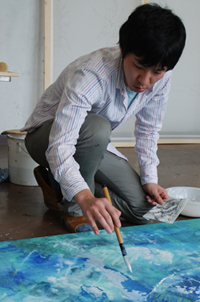
Education and research in the Nihonga (Japanese Painting) Course are centered on pursuing creativity in contemporary painting while also inheriting and refining the traditional techniques and spirit of Japanese art.
This philosophy has remained consistent since the establishment of the Tokyo Fine Arts School (the predecessor of the Tokyo University of the Arts) in 1887, and represents a touchstone for today’s artists and art educators. This tradition-based approach toward the creation of contemporary paintings is what established Nihonga as a distinct field within contemporary painting, one that encompasses a variety of elements while maintaining a unique identity. It has also served as the foundation for the development of many outstanding artists and researchers.
Today, the contemporary environment surrounding Japan ― not only in the realm of art but in society as a whole ― is undergoing profound change on a global scale, bringing with it dramatic changes in values and lifestyles. In this context of international transformation, we believe that the mission and guiding principle of the Department of Painting’s Nihonga Course are to cultivate young artists and researchers who understand how the materials and aesthetic sensibilities that have shaped and sustained Nihonga came into being, and who pursue the study of contemporary painting and expression with a strong sense of purpose and commitment to the future of Nihonga. We also believe that a deep understanding and critical examination of one’s own culture and traditions represents a profound inquiry into the nature of artistic expression, and serves as the first step toward genuine internationalization.
Policy
Curriculum Policy
 The aim of the Department of Japanese Painting is to nurture individuals having the potential to provide guidance in various fields related to artists and fine arts. To achieve this, the fundamental research and education in this department is centered on the pursuit of creativity in contemporary painting, as well as the inheritance and development of traditional and spiritual aspects of Japanese fine arts.
The Nihonga Course aims to cultivate artists and individuals who can assume leadership roles across a wide range of fields related to the arts. To achieve this goal, its educational and research activities are centered on the pursuit of creativity in contemporary painting, as well as the inheritance and development of the traditions and spirit of Japanese art.
Undergraduate Program: The first two years are the foundational stage of the program, with the goal of enabling students to acquire fundamental traditional techniques and develop their compositional and expressive abilities through a variety of assignments. The third and fourth years constitute the advanced development stage, where students focus primarily on independent projects and the creation of original works in order to refine and build upon the knowledge and skills acquired in the foundational stage.
Master’s Program: The program aims to expand on the research undertaken at the undergraduate level by enabling students to produce creative works according to their individual research themes while exploring diverse directions in painting. Students study traditional modes of expression while inheriting and developing them in the pursuit of innovative contemporary painting. Furthermore, the program aims to cultivate a deeper understanding of the materials that give form to artistic expression.
Doctoral Program: The program aims to provide master’s degree holders with the opportunity to further advance their creative and scholarly research while deepening their artistic thought and intellectual inquiry as they establish their own distinct artistic world. Furthermore, through a doctoral dissertation, students are expected to clearly define their research themes and consolidate the results of their investigations not only in practical terms but also from a theoretical perspective.
Diploma Policy
Undergraduate Program: A bachelor’s degree is awarded to students who have fulfilled the requirements of the aforementioned Curriculum Policy, obtained the required credits for graduation, and received a satisfactory evaluation for their graduation work in their final year.
Master’s Program: A master’s degree is awarded to students who have fulfilled the requirements of the aforementioned Curriculum Policy and received a satisfactory evaluation for their Master’s completion work in their final year.
Doctoral Program: A doctoral degree is awarded to students whose creative work and dissertation have been evaluated by a thesis evaluation committee composed of a supervisor in the concerned research field and faculty members in related fields, and who have been deemed to have fulfilled the requirements of the above Curriculum Policy and to be worthy of the degree.
Curriculum
Curriculum (undergraduate education)
The objective of the undergraduate program is to provide students with a thorough understanding of the artistic materials, and a refined sense of form through the study of the fundamental techniques of Nihonga, thereby cultivating the abilities necessary for creative artistic practice. The program also aims to nurture individuals who are capable of assuming leadership roles in a wide range of fields related to the arts.
Instruction at the undergraduate level is generally conducted through a cohort-based system in which multiple faculty members oversee each academic year. At the same time, to ensure that students are able to develop their talents freely, the program adopts a flexible educational and research framework that enables all faculty members to contribute to student instruction.
In the first and second years of the undergraduate program, students primarily engage in coursework aimed at developing fundamental skills in artistic composition and visual expression. Alongside studio assignments covering subjects such as the human figure, landscapes, still life, animals, plants, and independent themes, students also take part in practical training that includes classical painting reproduction, figure drawing, research into techniques and materials, and sketching trips.
In the third and fourth years, students are given increased opportunities for independent creative projects, allowing them to define their own artistic themes and thus develop their planning, conceptualization, and creative abilities essential for professional artistic practice. During the third year, students undertake printmaking and mural painting projects, as well as research excursions to Nara and Kyoto to study classical artworks, allowing them to approach Nihonga from a broader perspective. Alongside creative practice in the studio, students complete more advanced assignments in classical painting reproduction and techniques/materials research based on their individual mastery of Nihonga techniques and materials. Over the four-year curriculum, students study Nihonga comprehensively, not only through the creation of Nihonga works, but also through an in-depth exploration of its traditional techniques and materials.
Curriculum (graduate education and research)
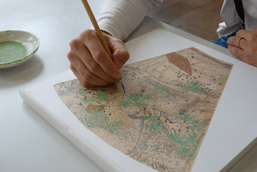
The Graduate Program is organized into three research studios, each offering an environment in which students pursue creative and research activities based on their individual research themes, under the guidance of several faculty members. Each studio also provides specialized educational and research programs, including practical training in a wide range of techniques and materials, as well as intensive lectures.
In the Master’s program, students build upon the knowledge and skills acquired at the undergraduate level with the aim of further developing their artistic abilities, including their skills in visual composition and creative expression, while also expanding their knowledge. Each research studio accommodates around four students per year level.
In the Doctoral program, students pursue advanced research in pictorial expression and gain specialized knowledge and theory by engaging not only in creative and research work but also in writing a doctoral dissertation. Through this process, they develop the expressive capabilities and theoretical foundation needed to thrive as artists and educators who can lead the next generation. For all research studios combined, the program enrolls roughly three students for each academic year.
* Studio 1: Building on Tradition
This studio seeks to explore new modes of expression through a contemporary understanding of tradition, based on each student’s day-to-day artistic practice. This involves practical experience in exhibitions planned and managed by the students themselves, as well as activities such as museum tours. Through these experiences, the studio aims to enable students to learn classical modes of expression and the diverse forms of contemporary artistic expression and presentation, and hence provide them with a foundation to thrive as artists with an international outlook.
* Studio 2: Inheriting and Building on Tradition
This studio focuses on research that forms the foundation of Nihonga expression. This includes materials research (paper, silk, ink, pigments, nikawa glue, brushes, and other tools and materials) as well as drawing research, exhibition practice sessions, and lectures. The studio views Nihonga production as an integration of conceptual development and materials research. Its aim is to cultivate contemporary Nihonga artists who can examine and express traditional materials and techniques within the context of the contemporary environment.
* Studio 3: Inheriting Tradition
The practice of reproducing classical works, including works designated as National Treasures, forms the foundation of Nihonga research, and serves as distinctive and highly valuable training. It also provides valuable opportunities to expand the possibilities of creative research, while emphasizing the study and inheritance of traditional techniques. In addition, the advanced level of classical work analysis required in these practical exercises serves as an essential practical educational program for students seeking to understand expression in traditional paintings.
Other information
*International exchange
Until now, the program has been involved in international exchange though the acceptance of students from overseas, study and research of Chinese Dunhuang murals, exchange at the researcher level for teachers returning to their home countries, and participation in joint exhibitions sponsored by the university, among other efforts. Today, as the social context for Japanese painting and the traditional painting of other nations undergoes dramatic transformation, the program is working to broaden exchange efforts, including joint student exchange.
*International students
The program has accepted students from Asian nations such as China and South Korea, as well as Western nations, including the United States, United Kingdom, and Austria. While most international students have come to Japan as research students funded by their national governmen
t, some have gone on to enroll in the master’s degree and doctoral programs after passing the necessary examinations.
* International Exchange
To date, international exchange activities have been conducted through the acceptance of international students, collaborative research and exchange programs related to the study of the Dunhuang murals in China, academic exchanges with former international students who have returned to their home countries and taken up teaching positions, and participation in joint exhibitions sponsored by the university. At a time when the social environments surrounding Nihonga and the traditional painting of other countries are undergoing dramatic transformation, the program is actively working to broaden these exchange efforts which include mutual exchanges among students.
* International Students
The program has accepted international students from various countries and regions around the world, including China, South Korea, Taiwan, India, the United States, Brazil, the United Kingdom, Austria, Iran, Greece, Belarus, and more. Some students come to Japan as exchange students from partner institutions, while others come as research students on government or private scholarships, many of whom continue their studies by passing the entrance examination and enrolling in the Master’s or Doctoral Programs.
 * Student Prospects After Graduation
Many graduates of the program pursue careers as professional artists, actively contributing to the art world through solo and group exhibitions both in Japan and abroad. Some have gained recognition by having their works selected for or awarded prizes at public exhibitions and competitions.
A large number of graduates also obtain teaching credentials and go on to work as art teachers at junior high schools and high schools, making significant contributions to art education.
Additionally, some graduates find employment in various fields, including instruction at cultural schools and examination preparatory schools, broadcasting, publishing, design-related industries, the video game industry, art museums, welfare facilities, and companies involved in art preservation and restoration.
Department/course summary

Since the establishment of the Western-style painting program based on a Japanese foundation at the Tokyo Fine Arts School in 1896, the university has steadily expanded and modified its program in the studies of oil painting, through an ongoing dialogue with current and emerging European, American, and international trends in the field.
Steady advances in the understanding and acceptance of various contexts have transformed the essence of oil-painting training, including ways of seeing and methods drawn from Western painting techniques and materials, expanding the implied meaning in different modes of painting expression. This has served a progressive and leading role in Japan’s artistic culture, which has modernized and grown increasingly international since the program’s founding. This trend has continued to evolve since the postwar period, through post-modernism, and into 21st-century practices.
The Oil Painting course has continually responded to ongoing changes in contemporary art, in a time in which artistic expression has expanded the field beyond traditional categories like painting and sculpture. This program has refined research and training in expressive techniques to include diverse media such as photography, film, video, performance, digital media, and new technologies in print-media, while maintaining a program of training in the core techniques based on conventional pictorial expressions.
The undergraduate program consists of basic topics addressed in the first and second years and specialized topics taught in the third and fourth years. The graduate program features a total of 13 studios focused on contemporary oil painting, printmaking, mural painting, and oil painting techniques and materials.
Policy
Curriculum Policy
Faculty: Currently, the Oil Painting Department aims at nurturing the capabilities of individuals who as professionals have already achieved the basis of fine arts and expressive arts, and can further acquire the essence of painting and conduct activities and new painting expressions in the 21st century. Practical education in oil painting involves a wide range of activities in fine arts with painting as the core conducted under the guidance of the entire faculty. In the first- and second-year foundational course, students acquire diverse drawing techniques promoting the exploration of themes and self-discovery through the range and depth of materials used. In addition, through practice with oil paintings, prints, murals paintings, and various oil painting techniques and materials, students are exposed to the practices and ideas of all the faculty members. This provides them with the opportunity to acquire a wide range of contemporary knowledge, technologies, media, and historical painting expressions. In the third- and- fourth-year specialized course, students conduct specialized research in line with their individual themes and undertake more specialized courses, training, or projects as necessary. These foundational and specialized courses have painting as the core value, along with conducting expressions in video, art installations, and practicing creative research for expression across all platforms. The institute is the alma mater of numerous global artists.
Master: In the Master’s Program, the students can conduct further specialized creative research in their own domain of expression. To nurture individuals to have rich originality and contribute to society, education that places importance on uniqueness is emphasized through individual guidance from each faculty member. In each studio, as a prerequisite, independent research and instruction is conducted in the form of close communication between the student and the respective teachers. At the same time, cross-disciplinary, collaborative guidance is also provided through joint-projects and joint-classes in several studios. Furthermore, to expand understanding about specialized domains in other areas and to acquire methods that connect the means and content of expressive art to expressions in fine arts that can contribute to society, the program includes intensive lectures that incorporate multifaceted perspectives and are conducted by several artists, curators, and critics from outside the department.
Doctor: In the doctoral degree program, a more advanced and comprehensive research with complex group guidance is conducted by the thesis and creative work supervisors and by several faculty members who support them, with the fundamental idea of working towards obtaining the doctoral degree. [Remark 1] Furthermore, through the further expansion of international fine arts activities, via joint-projects and study abroad exchange programs with partner universities, the program provides guidance for nurturing potential individuals who can disseminate their individual creative research activities to society.
Curriculum
Educational and research structure
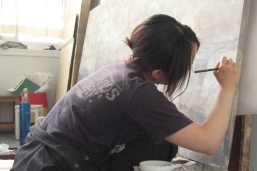 The undergraduate program consists of basic topics addressed in the first and second years and special topics taught in the third and fourth years. Through experience with a wide range of media, from drawing (the foundation of all creative painting) to specialized practical oil-painting techniques, students learn to express themselves in paint and learn to handle a wide range of expressive techniques. From the third year, students can choose to be assigned to printmaking studios to work within a more specialized curriculum.
The graduate program features a total of 13 studios focused on oil painting, printmaking, mural painting, and oil painting techniques and materials. Graduate-level training and research seek to make the most of each studio’s characteristics, with emphases ranging from research to creative work, based on student research themes and the specialties of each studio.
Curriculum (undergraduate education)
The first year of undergraduate education occurs at the Toride Campus. The core of the curriculum is drawing, the foundation of all creative painting, which is studied for an entire year. From the second semester of the first year through the entire second year, students study practical oil-painting techniques – the department’s area of specialization – while also learning about the full range of two- and three-dimensional expressive media through work with visual media such as photography and video and materials such as clay, stone, wood, metal, and plastic, as well as installations. This approach is intended to draw out the potential expressive capabilities of each student. Students are also exposed to opportunities to gain actual experience with mixed-media techniques using egg tempera and oil colors; expressive techniques for murals (e.g., frescoes, mosaics, and stained glass); and expressive techniques in printmaking, such as copperplate, wood-block printing, lithography, and screen-printing.
Third- and fourth-year work focuses on creative research undertaken by each student independently. The third year features a two-week trip to study ancient art, chiefly in Nara and Kyoto, providing students with the opportunity to discover something new about themselves by experiencing ancient art works, including Buddha statues and screen and wall paintings.
In this way, the four-year undergraduate program promotes a process whereby students discover their own essential nature and identify and deepen both the content of their own expression and the means of expression as part of an active dialogue with the diverse modes of artistic expression from antiquity to the present day.
In the entire fourth year of the program, students work on their thesis projects, intended to represent the culmination of their training.
Details of undergraduate education for first- through fourth-year students
*First and second years of the undergraduate program (basic topics)
Fundamentals and possibilities of oil painting
The first year of the undergraduate program entails creative and research work at the Toride Campus. The core of the curriculum is a year-long course in drawing (the foundation of all creative painting) required for all students. Basic guidance is provided in practical techniques, including basic elements of painting (images, substance, behavior, and the environment).
Students learn about painting materials and techniques from before the advent of oil painting – frescoes, mosaics, stained glass, and tempera – examining how painting evolved from antiquity. In the second semester, students learn practical planning and management skills and present the results of their creative research in an exhibition. The Toride Campus offers a number of workshops, including workshops in painting materials, stone, printmaking, and photography. As part of an intensive basic program incorporating highly specialized practical techniques and theory, classes and workshops create a special environment that encourages students to learn about the relationships between various media and painting and the possibilities generated through these links.
Students transfer to the Ueno Campus for the second year of the undergraduate program, where they continue to explore the possibilities generated by the painting fundamentals learned during the first year. The curriculum offers various year-long electives. Works and exhibitions are shown to the public in a presentation given at the end of the school year in a culmination of student studies in basic topics. These presentations are reviewed by all instructors. Students passing advance to the study of special topics from the third year of the program.
*Third and fourth years of undergraduate program (special topics)
Development and independence of expression – thesis project
In the special topics sequence, focusing on independent creative research by each student, students receive special guidance in practical techniques to develop and deepen the content of their expressive skills and their means of expression.
The third year of the undergraduate program features a two-week trip to study ancient art, chiefly in Nara and Kyoto. This gives students the opportunity to discover something new about themselves through encounters with ancient art works, including screen and wall paintings, architecture, sculpture, and environmental works such as gardens.
In this way, the four-year undergraduate program promotes a process whereby students discover their own essential nature and identify and deepen both the content of their own expression and the means of expression as part of active dialogue with the diverse modes of artistic expression from antiquity to the present day. In the entire fourth year of the program, students work on their thesis projects, intended to represent the culmination of their training.
Curriculum (graduate education and research)
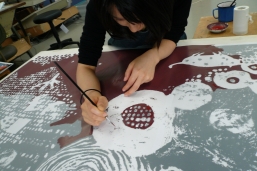 The graduate school’s master’s degree program in oil painting features seven studios that provide each student with individual guidance under an educational system that respects each student’s individuality. The goal is to develop individuals capable of contributing to society through original creative work or research. In the program, students pursue increasingly advanced creative and research work in their own areas of interest. Within each studio, students work independently under the close guidance of a faculty adviser.
Guidance is also provided through cross-functional coordination in joint projects and combined classes administered by multiple studios. In addition to deepening understanding of other specialized areas and learning how to link content to effective modes of expression in the current social context, the program invites a number of outstanding figures from outside the university, including artists, curators, and critics, to provide intensive lectures on numerous topics.
In the doctoral program, comprehensive, integrated group guidance is provided at more advanced levels by primary and support instructors, on both creative work and theory, to support students in completing doctoral degrees. Guidance also focuses on providing students with the skills needed to present their own creative and research activities within society and to mature into specialists capable of pursuing careers in art on the international stage.
Other information
*International exchange
As demonstrated by the fact that it was called the Western painting program in the days of the Tokyo Fine Arts School, the Oil Painting Course in the Department of Painting is a program that pursues creative work and research from an international perspective. Together with the growing numbers of schools with whom the university has concluded international exchange agreements in recent years, this program is taking an aggressive approach to international exchange. Each year, it holds joint exhibitions, joint classes, workshops, and other activities both in Japan and overseas. These events are attended by representatives from institutions drawn from both Eastern and Western nations, including the Queensland College of Art, Griffith University, the China Academy of Art, and the School of the Art Institute of Chicago.
*International student enrollment
In light of the international nature of arts training and research and the sophistication of the graduate program and in order to promote more open international exchange, this program actively promotes the development of an infrastructure for accepting more international students. It has consistently welcomed large numbers of international students from Asian nations such as South Korea, China, Thailand, India, and Pakistan, as well as Western nations including France, Germany, Austria, the United States, Canada, and Australia. The program makes significant contributions to international goodwill and international cultural exchange.
*Student prospects after graduation
While most graduates advance to the university’s graduate school, numerous others are working artists who exhibit their own work in various public exhibitions, competitions, and individual exhibitions. Others serve as instructors at crafts colleges, arts colleges, educational colleges, arts preparatory schools, specialized schools, middle schools, high schools, and other educational institutions.
In recent years, increasing numbers of graduates have found work in the areas of film and video production, including creative work in the videogame and video content industries. Some graduates win funding from the national government to study overseas in North America, Europe, and elsewhere. Certain numbers of international students receive funding from various other nations.
Department/course summary
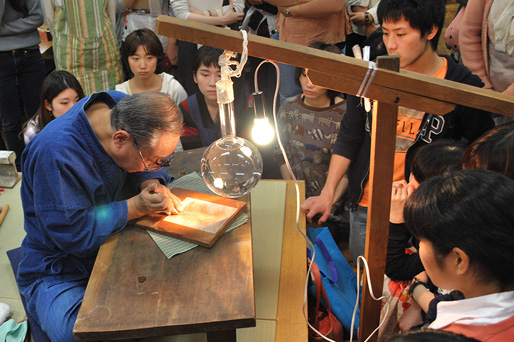 Printmaking is an attractive medium of expression in that: it serves as an indirect communication vehicle; the materials used convey a strong sense of physical reality; and it is a robustly physical form of expression with a variety of print types.
The printmaking studio teaches basic printmaking techniques through practical training in the four main print technologies of copperplate, lithography, wood-block printing, and screen-printing. In addition to deepening student understanding of the characteristics of expression for each print type, it deepens creativity and research based on the historical and social backgrounds
in which printmaking has evolved while incorporating the plethora of artistic genres that have developed since printmaking first appeared as a simple printing medium.
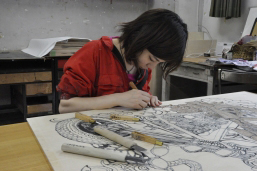
Since 1970, the program has provided two years of basic training for undergraduates as part of a program transferred from the third year of the Oil Painting Course. Since 1967, this studio, which serves as a communal workshop within the university, has opened its doors to those enrolled in the Oil Painting, Japanese Painting, and Art and Education courses as well as the Design (through 1975) and Aesthetics and Art History departments, based on intensive lectures on basic methods and techniques. While continuing to serve as one component of an overall education in the painting arts in accordance with each of these curricula, the program also pursues training and research specific to print expression, seeking to develop in individuals the skills and capabilities needed to contribute to society at large and to develop artists capable of thriving not just in Japan but internationally, based on foundations incorporating the basic methods and techniques of each print type and research into printmaking materials.
Curriculum
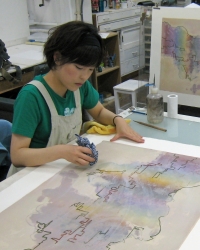 Graduate education in the printmaking studio is based on a number of intensive lectures which are open to those enrolled in other departments and courses, including Japanese Painting and Aesthetics and Art History. For students of each print type – copperplate, lithography, wood-block printing, and screen-printing – the curriculum focuses on creative research. Students can join basic practical training and materials research programs targeted at third- and fourth-year undergraduates, incorporating these activities into their work at their own discretion. Space for displaying student work, known as the print gallery, is available in front of the studio, serving as a space where students can present current work on their own. Work is also presented outside the confines of the university through group exhibitions, competitions, and individual exhibitions. Instructors also exhibit work, both individually and as a faculty, in galleries, museums, and other venues.
Japanese printmaking is regarded highly on the international stage, and numerous international students seek to study in the program. Numerous students have been accepted from Asian nations such as South Korea, China, Thailand, India, and Pakistan, as well as Western nations including France, Germany, Austria, the United States, Canada, and Australia. This program contributes significantly to international goodwill and cultural exchange.
In the doctoral program, comprehensive, integrated group guidance is provided at more advanced levels by primary and support instructors, on both creative work and theory, to support students in completing doctoral degrees. Guidance also focuses on providing students with the skills needed to present their own creative and research activities within society and to mature into specialists capable of pursuing careers in art on the international stage.
Department/course summary
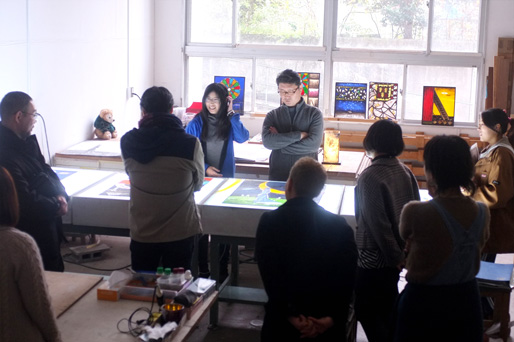 The mural painting studios trace their history back to 1957, when fresco painting was adopted as a course of study in practical oil-painting techniques. A fresco studio was established in the Oil Painting Course in 1960, with training in practical mosaic skills following in 1962. In 1963, another fresco studio was established concurrently with the graduate school. This became the printmaking and mural painting studio the following year.
In 1969, the mural painting program and the Japanese-painting classical reproduction program merged and founded an independent mural painting studio. In 1972, stained glass was adopted as a material studied in the oil painting program. The mural painting studio split from the Japanese painting classical reproduction program in 1973, when mural painting became an independent program within the Oil Painting Course – to which it belongs today – with two studios of its own.
 The mural painting studios continue to serve in their historical roles of specialized training and research in the areas of frescoes, mosaics, and stained glass. Since classical methods of expression combined with buildings and living environments are essential to learning fundamental concepts, methods and materials, and expressions in murals, mural painting is offered as an elective program for first-year students in the Oil Painting Course. Numerous specialized intensive classes are also offered.
The mural painting studios pursue training and research in the field of mural expression and train a wide range of graduates. They focus on research and the exploration of new theories and modes of expression for today’s society while continuing to emphasize historical continuity.
Curriculum
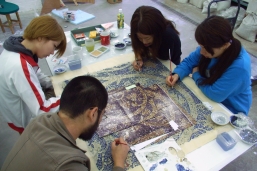 The mural painting studios engage in training and research to develop individuals with broad-ranging knowledge and skills in mural expression, focusing on both historical continuity and research and the study of new theories and expressions within the current social context.
In mural studio no. 1, students explore the creative process in art and culture through a wide range of projects. The genre of mural painting has developed in close relation to the way people live, the environment, and society since ancient times, and certain aspects of this genre must be addressed by studying human creative activities. Based on this perspective, the program explains how to make mural paintings that are socially accepted, and cultivates observation skills, imagination, and artistic motivation in order to enable students to bring interpretive powers to bear in a variety of fields. This approach seeks to instill an understanding of art within the context of contemporary thought, media, and techniques, while focusing on creativity that leads to a deeper understanding of expressive potential.
The chief focus of mural studio no. 2 is the study and acquisition of the techniques of classical Western murals (mosaics, frescoes, and stained glass) and individual works through the application of such techniques. The curriculum is designed to be both specialized and cross-functional, allowing students to experiment with materials and techniques and deploy these in their own work, based on the genre’s close relationship to the natural environment, the urban environment, and architecture, free of the constraints imposed by these three media. This approach proceeds from a fundamental understanding of mural painting as an art form that represents an integral part of environments and structures.
In the doctoral program, comprehensive, integrated group guidance is provided at more advanced levels by primary and support instructors, on both creative work and theory, to support students in completing doctoral degrees. Guidance also focuses on providing students with the skills needed to present their own creative and research activities within society and to mature into specialists capable of pursuing careers in art on the international stage.
Department/course summary
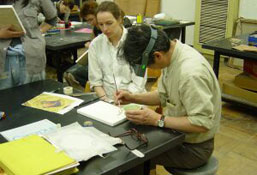 The oil painting technique and material studio seeks to identify each student’s potential in painting expression, based on the student’s creation of oil paintings as an act of self-expression. Addressing topics such as “What is the essential nature of oil paintings?” and “How oil paintings originated and developed,” in terms of painting materials and techniques, it seeks to deepen understanding through practical training, lectures, and seminars. Students study oil-painting materials and techniques through various activities, including work in reproducing paintings on site, creating their own canvas material, undercoating, and palette, with the ultimate goal of creating successful modern oil-based works.
The oil painting technique and material studio offers courses on the historical materials of painting for first-year undergraduate students enrolled in the Oil Painting Course as well as other courses, including Japanese Painting. At the Toride Campus, the studio offers courses on basic painting, particularly materials and historical techniques. It also offers practical training in undercoating for first-year students enrolled in the Oil Painting Course and provides guidance on other practical techniques, including assembling wooden frames, stretching the canvas, gluing, and undercoating (chalk and emulsion), including undercoating when using a wooden panel as a canvas.
Under a comprehensive educational structure based on practical techniques, practice, and theoretical study of the basics of painting structure and based on students’ own individual autonomy and broadmindedness, the studio promotes training and research that respect the individuality of each student.
Curriculum
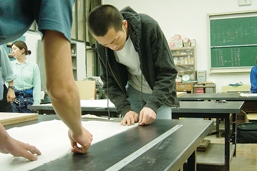 In the oil painting technique and material studio, students address topics such as “What is the essential nature of oil paintings?” and “How oil paintings originated and developed” in terms of painting materials and techniques, and based on the results of study on such topics, they are involved in the creation of oil paintings as a means of self-expression. Students also study oil-painting materials and techniques through various tasks, including creating their own canvases, undercoatings, and palettes, with the ultimate goal of creating successful modern oil-based works.
Students examine the actual conditions of tempera painting in the early Italian Renaissance by reproducing, in sequence, the canvases, undercoatings, and palettes of classical Western tempera and oil paintings, as well as studying the literature on oil-painting materials and techniques and practical training in reproduction. Photographic instruction imparts photographic, enlarging, development, and printing techniques for copying the students’ own (mainly two-dimensional) works and human subjects. Based on the results of these studies, students prepare reports that combine photographs and text as presentations of their own work and engage in frequent discussions with instructors and other students.
Research and study over many years has concentrated on the numerous outstanding Japanese oil paintings dating from the early Meiji period currently in the collection of the University Art Museum. Focusing on the multilayered structure of the paintings and various materials, including canvases, undercoatings, palettes, and varnish, students and researchers have meticulously described the condition of each work through text and photographs. This work is digitally archived and stored in a database.
The graduate school enrolls numerous students interested not just in oil painting but diverse, complex works such as three-dimensional works, images, and installations that lie outside the genre of oil painting. Students in all these areas share a common approach to deepening their knowledge of the classics and learning about new art through such works. By design, the program offers an educational and research structure in which each student can direct his or her studies to grapple with the essential nature of oil paintings within a traditional academic setting.
In the doctoral program, comprehensive, integrated group guidance is provided at more advanced levels by primary and support instructors, on both creative work and theory, to support students in completing doctoral degrees. Guidance also focuses on providing students with the skills needed to present their own creative and research activities within society and to mature into specialists capable of pursuing careers in art on the international stage.